

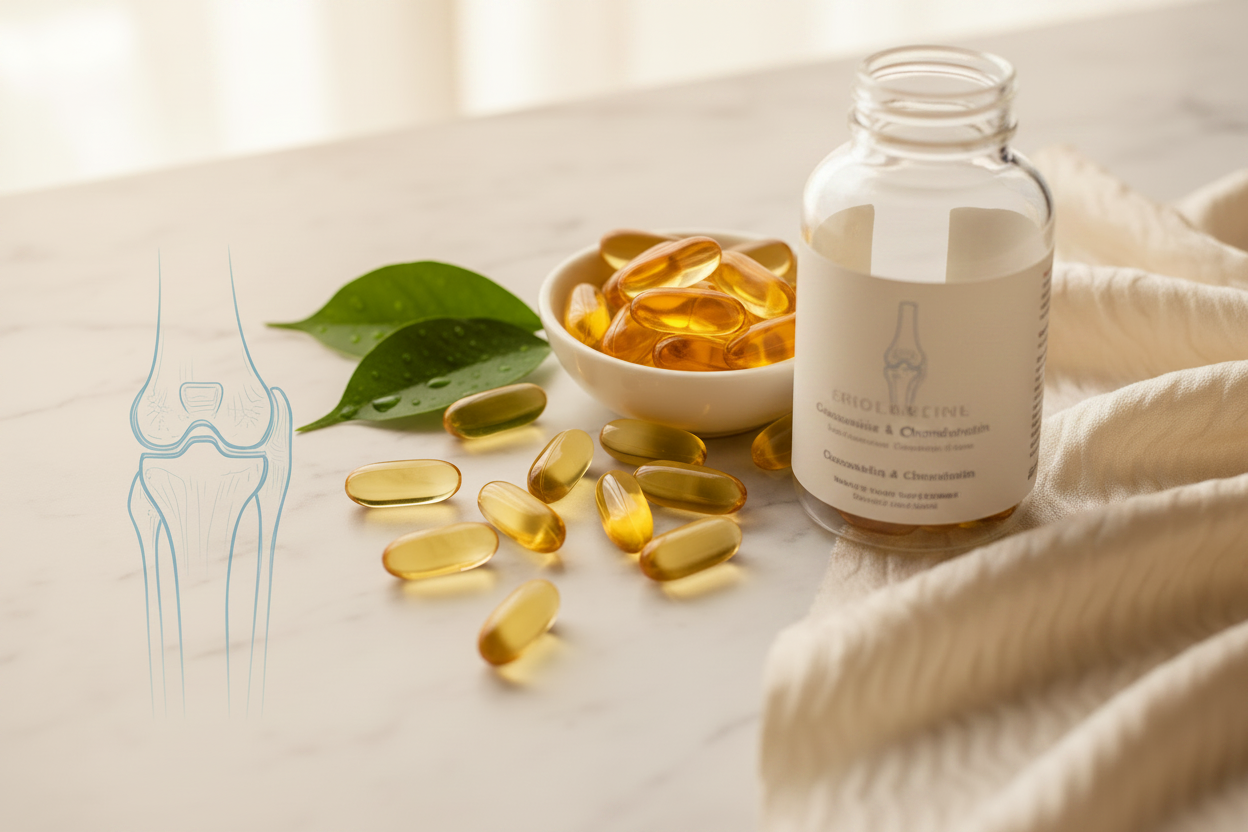
Glucosamine and chondroitin are natural components of cartilage, the tissue that protects and cushions joints. These compounds have been extensively studied for their potential role in maintaining joint health and are frequently used in dietary supplements aimed at supporting joints.
What are glucosamine and chondroitin?
Glucosamine and chondroitin are structural components of cartilage, the tissue that cushions and protects joints. Both are naturally produced by the body.
How do glucosamine and chondroitin work?
Glucosamine is used in the synthesis of glycosaminoglycans, essential molecules for the formation and repair of cartilage and other connective tissues in the body.
Chondroitin is the most abundant glycosaminoglycan in cartilage, contributing to its elasticity and strength. Furthermore, it has been studied for its potential role in inhibiting enzymes that can contribute to cartilage degradation.
What are the dietary sources of glucosamine and chondroitin?
Dietary sources of glucosamine are limited, found mainly in the shells of crustaceans such as shrimp, lobster, and crab.
Chondroitin is primarily obtained from animal cartilage, namely bovine and shark.
Who might benefit from a glucosamine and chondroitin supplement?
When diet does not provide these compounds, supplementation with glucosamine and chondroitin may be considered by adults who wish to support joint health, namely:
- People with knee or hip osteoarthritis and joint discomfort. Progressive cartilage degradation can contribute to pain, stiffness, and limited movement. Some studies suggest that glucosamine and chondroitin may provide modest symptom relief in some individuals with knee osteoarthritis, although research results are inconsistent.
- Physically active people or athletes, who want to supplement their diet while maintaining an active lifestyle and supporting the health of joints subjected to repetitive stress.
What is the importance of combining MSM, turmeric, and vitamin C with this supplement?
Methylsulfonylmethane (MSM) is a naturally sulfur-rich compound that has been studied for its potential role in joint health. Some studies suggest it may contribute to joint comfort and physical function in certain individuals, although more studies are needed to confirm these effects.
Turmeric (Curcuma longa), also known as Indian saffron or curcuma, is a plant rich in curcuminoids. It has been extensively investigated for its antioxidant properties and its potential role in joint comfort and general well-being. Despite promising results, many of these applications are still under investigation.
Vitamin C contributes to the normal formation of collagen, which is necessary for the normal functioning of cartilage, bones, and connective tissues.
What are the adverse effects associated with this supplement?
Over the years, several studies have shown that glucosamine and chondroitin are generally well-tolerated when used at recommended doses.
However, glucosamine may interfere with the anticoagulant warfarin, increasing the risk of bleeding.
It may also influence glucose metabolism in some people, particularly in individuals with diabetes, insulin resistance, or glucose intolerance. In these cases, it is recommended to consult a healthcare professional before starting supplementation.
Some people may also experience mild adverse effects, such as gastrointestinal discomfort, nausea, or diarrhoea.
Conclusion
Glucosamine and chondroitin are natural components of cartilage widely used in dietary supplements aimed at supporting joint health.
The available scientific evidence suggests that these supplements may provide a modest benefit in some individuals with osteoarthritis, particularly of the knee, although study results are not consistent and response may vary between individuals. Further research is still needed to clarify their role in maintaining joint health.
Like any food supplement, they should be used as a complement to a varied and balanced diet and a healthy lifestyle.
The information presented in this article is for informational purposes only and does not replace medical advice or that of a healthcare professional. Food supplements should not be used as substitutes for a varied and balanced diet and a healthy lifestyle.
References
Bannuru, R.R. et al., 2019. OARSI guidelines for the non-surgical management of knee, hip and polyarticular osteoarthritis. Osteoarthritis and Cartilage, 27, pp.1578–1589.
Bruyère, O. et al., 2019. An updated algorithm recommendation for the management of knee osteoarthritis. Seminars in Arthritis and Rheumatism, 49(3), pp.337–350.
Daily, J.W. et al., 2016. Efficacy of turmeric extracts and curcumin for alleviating symptoms of joint arthritis: A systematic review and meta-analysis. Journal of Medicinal Food, 19(8), pp.717–729.
Debbi, E.M. et al., 2011. Efficacy of methylsulfonylmethane supplementation on osteoarthritis of the knee. BMC Complementary and Alternative Medicine, 11, 50.
Henrotin, Y., Mobasheri, A. & Marty, M., 2012. Is there any scientific evidence for the use of glucosamine in the management of human osteoarthritis? Arthritis Research & Therapy, 14(1), 201.
Hewlings, S.J. & Kalman, D.S., 2017. Curcumin: A review of its effects on human health. Foods, 6(10), 92.
Institute of Medicine (US), 2000. Dietary Reference Intakes for Vitamin C, Vitamin E, Selenium and Carotenoids. Washington, DC: National Academies Press.
Kolasinski, S.L. et al., 2020. 2019 American College of Rheumatology Guideline for the Management of Osteoarthritis of the Hand, Hip, and Knee. Arthritis Care & Research, 72(2), pp.149–162.
National Center for Complementary and Integrative Health (NCCIH). Glucosamine and Chondroitin for Osteoarthritis. Bethesda, MD: NCCIH.
Reginster, J.Y. et al., 2001. Long-term effects of glucosamine sulphate on osteoarthritis progression: A randomised, placebo-controlled clinical trial. The Lancet, 357(9252), pp.251–256.
Reginster, J.Y. et al., 2007. Role of glucosamine and chondroitin sulfate in the treatment of osteoarthritis. Rheumatology International, 27, pp.1–7.

Leave a comment
This site is protected by hCaptcha and the hCaptcha Privacy Policy and Terms of Service apply.