
Few trees are as deeply linked to Mediterranean history and culture as the olive tree (Olea europaea).
With its gnarled trunk and extraordinary longevity, this tree has graced the Portuguese landscape for centuries and has become a true symbol of peace, tradition, and connection to nature.
At Hands on Earth, we believe that every plant has a story to tell. The olive leaf is a special example: a lesser-known part of the olive tree, but with a long tradition of use and a delicate flavour when prepared as an infusion.
A tree with thousands of years of history
The olive tree is an evergreen tree native to the Mediterranean region, where it found ideal conditions to grow and thrive.
Its presence accompanies some of the oldest Mediterranean civilizations. Greeks and Romans already valued the olive tree and its fruits, using olive oil in food, personal care, and various cultural practices.
The olive tree also became an essential element of the Mediterranean landscape and diet, a tradition that remains alive to this day.
The universal symbol of peace
The olive tree has been associated with peace for centuries.
One of the most well-known references appears in the Old Testament, when a dove returns to Noah's Ark with an olive branch in its beak, announcing that the waters were beginning to recede.
In Ancient Greece, olive leaves also had a special meaning. The winners of the Olympic Games were crowned with wreaths made of olive branches, symbolizing honour and recognition.
The olive leaf in tradition
Although olive oil and olives are the best-known products of the olive tree, its leaves are also part of Mediterranean tradition.
Dried and prepared as an infusion, they offer a light and pleasant-tasting drink that can be enjoyed hot or cold.
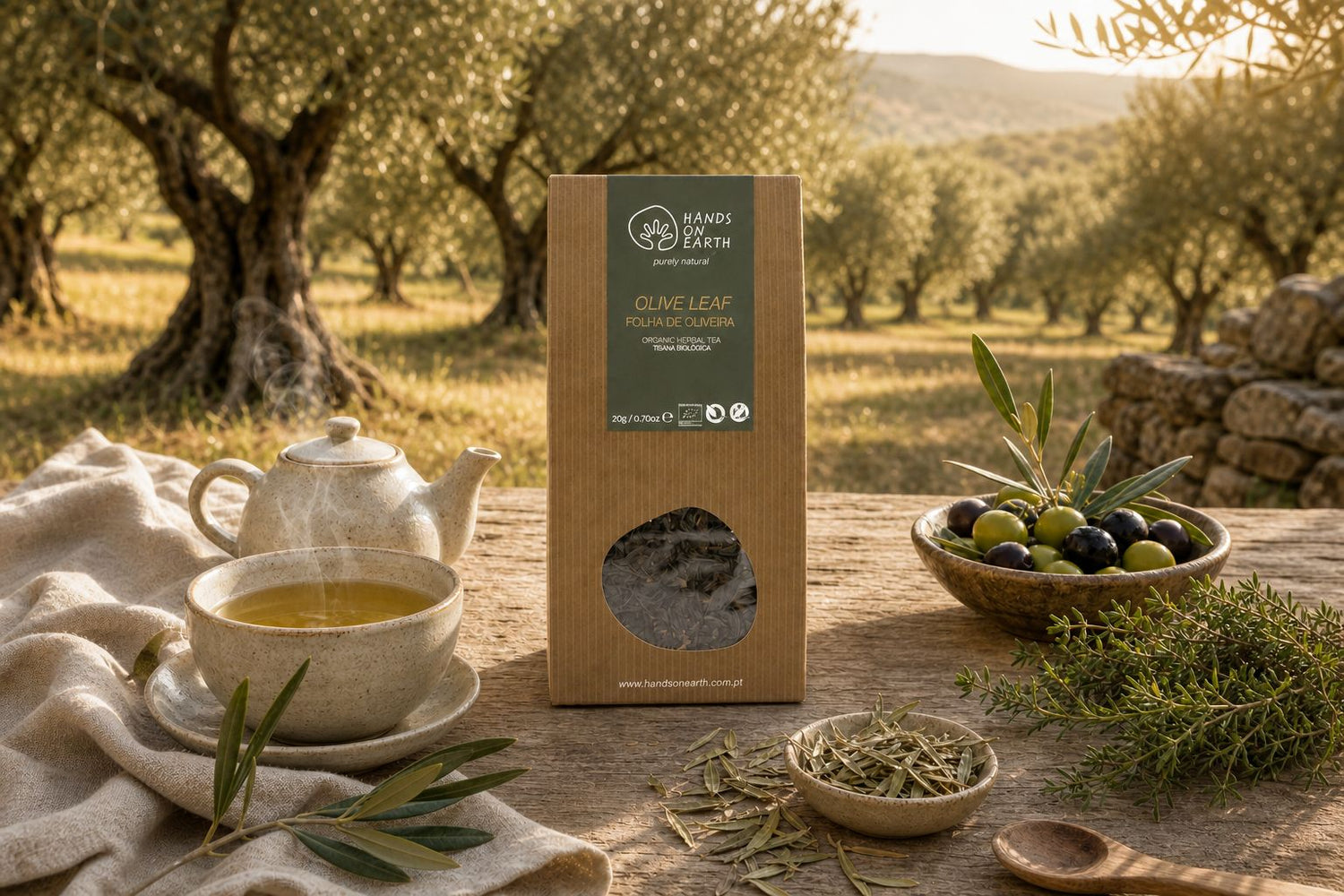
The Hands on Earth Organic Olive Leaf Herbal Tea is prepared exclusively with dried olive leaves from organic farming, preserving the simplicity and authenticity of this traditional plant.
A light and caffeine-free infusion
In addition to its traditional use, olive leaf can be enjoyed as an infusion.
Prepared with carefully dried olive leaves, it offers a light-tasting drink with a delicate aroma that can be enjoyed hot or cold.
Naturally free of caffeine and theine, it is a pleasant option for any time of the day.
Organic farming and respect for nature
At Hands on Earth, we believe that quality begins at the source.
Our Organic Olive Leaf comes from organic farming, where cultivation respects the soil, biodiversity, and natural cycles of plants.
After harvesting, the leaves are carefully dried to preserve their aroma, flavour, and natural characteristics.
Discover Hands on Earth Olive Leaf
The olive leaf continues to represent the richness, history, and tradition of Mediterranean culture.
Whether for preparing a hot or cold infusion, this plant offers a simple way to appreciate one of the most emblematic species of Portuguese nature.
At Hands on Earth, you will find our Organic Olive Leaf Herbal Tea, produced with carefully selected and prepared leaves to preserve all the authenticity of the olive tree.
We also invite you to discover our collection of Teas and Infusions, where each plant is chosen for its quality, origin, and tradition.
References
Knöss, W., 2018. Current regulatory environment of herbal medicinal products in the European Union. In Natural products as source of molecules with therapeutic potential: research & development, challenges and perspectives (pp. 365-389). Cham: Springer International Publishing.
El, S.N. and Karakaya, S., 2009. Olive tree (Olea europaea) leaves: potential beneficial effects on human health. Nutrition reviews, 67(11), pp.632-638.
Soler‐Rivas, C., Espín, J.C. and Wichers, H.J., 2000. Oleuropein and related compounds. Journal of the Science of Food and Agriculture, 80(7), pp.1013-1023.
Hashmi, M.A., Khan, A., Hanif, M., Farooq, U. and Perveen, S., 2015. Traditional uses, phytochemistry, and pharmacology of Olea europaea (olive). Evidence‐Based Complementary and Alternative Medicine, 2015(1), p.541591.
Contreras, M.D.M., Gómez-Cruz, I., Galán-Martín, Á., Romero, I. and Castro, E., 2023. Green extraction techniques applied to recover chemical compounds from olive-derived biomasses. In Agricultural Waste: Environmental Impact, Useful Metabolites and Energy Production (pp. 415-452). Singapore: Springer Nature Singapore.
Abaza, L., Taamalli, A., Nsir, H. and Zarrouk, M., 2015. Olive tree (Olea europeae L.) leaves: Importance and advances in the analysis of phenolic compounds. Antioxidants, 4(4), pp.682-698.

Leave a comment
This site is protected by hCaptcha and the hCaptcha Privacy Policy and Terms of Service apply.