

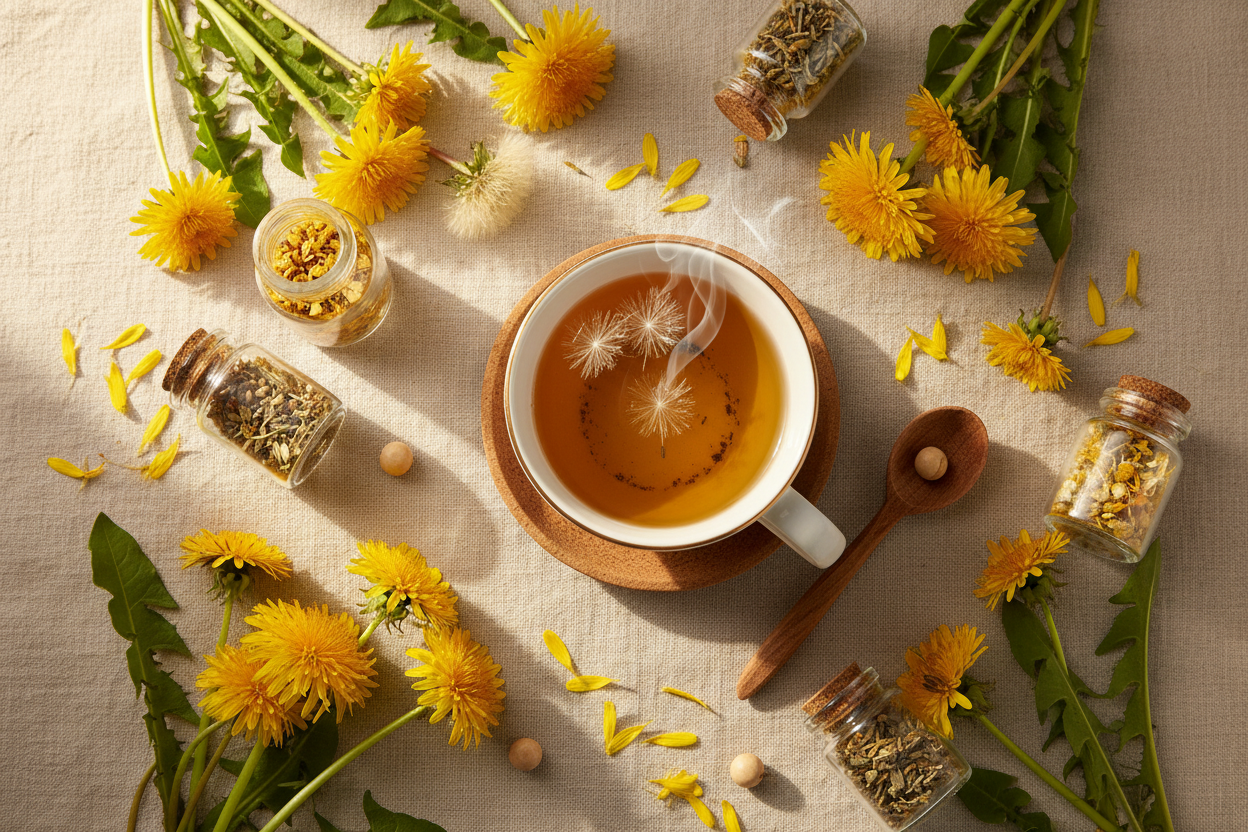
Few wild plants are as recognizable as dandelion (Taraxacum officinale). With its bright yellow flowers and delicate white seed spheres that dance in the wind, this plant has accompanied the European landscape for centuries and continues to spark curiosity in children and adults alike.
At Hands on Earth, we believe that plants tell stories. Dandelion is an excellent example of this: a resilient, versatile species deeply connected to nature, tradition, and the gastronomy of various European regions.
A plant found worldwide
Dandelion belongs to the Asteraceae family, the same family as daisies and sunflowers.
It is native to Europe and Asia, but is now distributed across much of the world, growing spontaneously in meadows, fields, gardens, orchards, and along roadsides. Its extraordinary adaptability allows it to thrive in different types of soil and climate.
The scientific name, Taraxacum officinale, originates from Greek and Latin. The designation "officinale" was traditionally given to plants cultivated in monastery gardens and used over the centuries for their traditional applications.
While often considered merely a wildflower, dandelion plays an important role in biodiversity, providing nectar and pollen to bees and many other pollinating insects, especially in early spring.
Why is it called dandelion?
The name dandelion comes from the jagged shape of its leaves, whose margins resemble a lion's teeth.
Over the centuries, this plant has received various popular names. In Brazil, it is also known as "taráxaco", "papai-careca" (bald daddy), "vovô-careca" (bald grandpa), or "amor-de-homem" (man's love), names inspired by the appearance of its characteristic white seed heads.
These names demonstrate how a simple wild plant has earned a special place in the popular traditions of different cultures.
Seeds that travel with the wind
Few images represent the delicacy of nature as well as the white sphere formed by dandelion seeds.
After flowering, each flower transforms into a perfect sphere composed of hundreds of tiny seeds. Each one has a thin natural "parachute," known as a pappus, which allows the wind to carry them over long distances.
Thanks to this ingenious mechanism, dandelion can spread naturally and colonize new spaces.
For generations, children around the world have blown these spheres while making a wish, believing that the wind would carry their dreams with it. This small tradition remains one of the most beautiful images associated with the plant.
A plant appreciated since Antiquity
Dandelion has accompanied the history of humanity for many centuries.
Various European and Asian peoples used different parts of the plant in their diet and local culinary traditions. It was also common to find it in the gardens of medieval monasteries, where numerous aromatic and edible plants were cultivated.
Today it continues to be appreciated for its versatility and its value as a spontaneous plant that enriches the biodiversity of natural landscapes.
A plant where almost everything is used
One of the most interesting characteristics of dandelion is that practically the entire plant can be used.
Young leaves are enjoyed in salads, while flowers can be used in syrups, jellies, and other traditional preparations. Stems and roots are also part of the gastronomy of various European regions.
This versatility has made dandelion one of the best-known edible wild plants.
Dandelion in the kitchen
With a slightly bitter, herbaceous flavor, dandelion pairs well with a wide variety of dishes.
Traditionally, it can be used in:
- Fresh salads
- Soups
- Sautéed vegetables
- Baked dishes
- Grilled fish
- Grilled meats
- Traditional country-inspired recipes
The flowers are also used in some European countries to prepare artisanal jellies and syrups.
A naturally caffeine-free infusion
In addition to its culinary use, dandelion can be enjoyed as an infusion.
Prepared with carefully dried leaves, stems, and flowers, it offers a drink with an herbaceous aroma and a naturally slightly bitter taste, which can be enjoyed hot or cold.
Like other herbal infusions, it is naturally caffeine and theine-free, making it an excellent option for any time of day.
Organic farming and respect for nature
At Hands on Earth, we believe that quality begins at the source.
Our Organic Dandelion comes from organic farming, where cultivation respects the soil, biodiversity, and the natural cycles of plants.
After harvesting, the leaves, stems, and flowers are carefully dried to preserve their aroma, color, and natural characteristics of the plant.
Discover Hands on Earth Dandelion
Dandelion continues to surprise with its simplicity, beauty, and versatility.
Whether to prepare an aromatic infusion or to explore new recipes inspired by tradition, this plant represents an authentic connection between nature and gastronomy.
At Hands on Earth, you will find our Organic Dandelion Herbal Tea, produced with carefully selected ingredients and prepared to preserve all the authenticity of this wild plant.
We also invite you to discover our collection of Teas and Infusions and other Organic Aromatic Herbs, where each plant is chosen for its quality, origin, and tradition.
References
Engels, G. and Brinckmann, J., 2016. Dandelion. HerbalGram, (109).
Wu, J., Sun, J., Liu, M., Zhang, X., Kong, L., Ma, L., Jiang, S., Liu, X. and Ma, W., 2024. Botany, traditional use, phytochemistry, pharmacology and quality control of taraxaci herba: comprehensive review. Pharmaceuticals, 17(9), p.1113.
Biggs, M., 2018. RHS The Secrets of Great Botanists: and What They Teach Us About Gardening. Hachette UK.
Chevallier, A., 2018. Herbal Remedies Handbook: More Than 140 Plant Profiles; Remedies for Over 50 Common Conditions. Penguin.
Grieve, M., 2013. A modern herbal, Vol. II (Vol. 2). Courier Corporation.

Leave a comment
This site is protected by hCaptcha and the hCaptcha Privacy Policy and Terms of Service apply.