

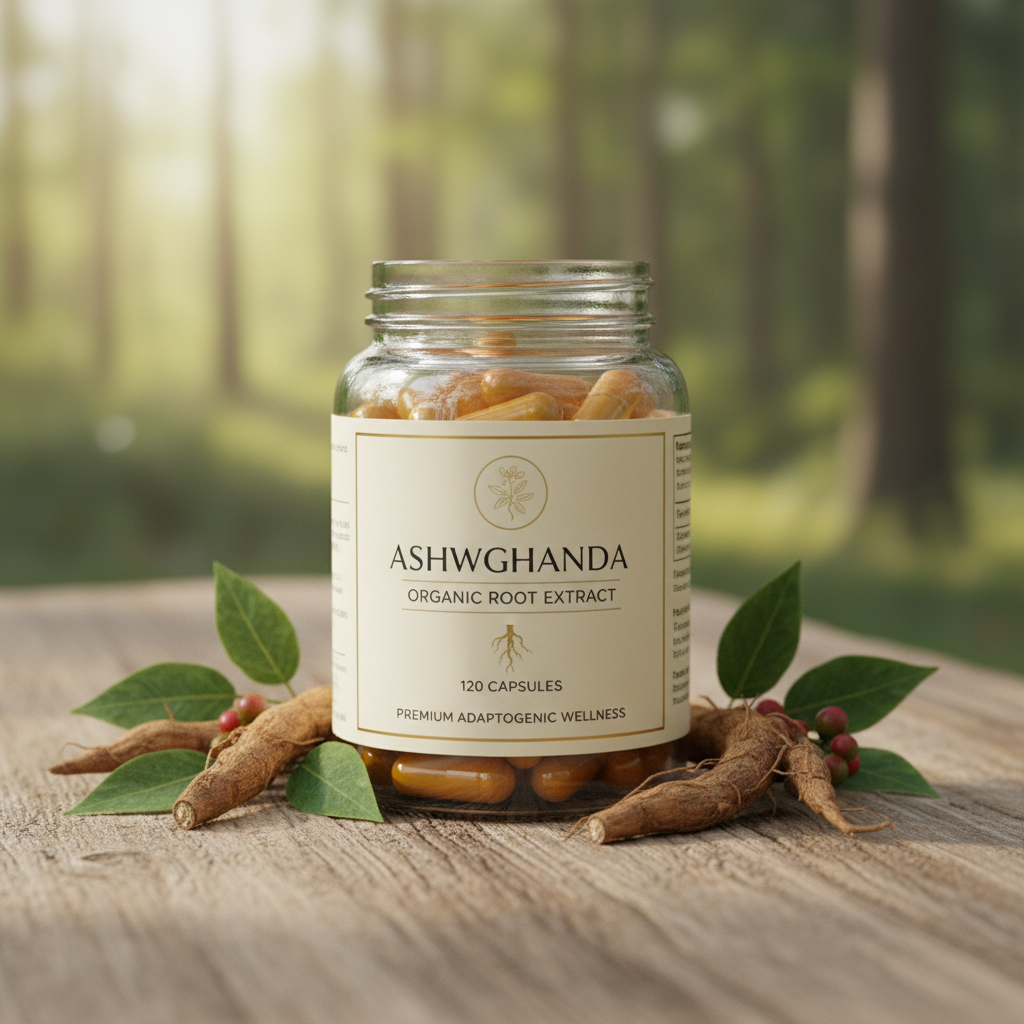
Ashwagandha is one of the most important plants in traditional Ayurvedic medicine, used for centuries to promote physical and mental well-being. Also known as "Indian ginseng" or "winter cherry", this plant has attracted growing scientific interest due to its potential role in stress adaptation, sleep quality, cognitive function, and physical performance.
The name "ashwagandha" means "smell of horse" in Sanskrit, referring to the characteristic aroma of the root and, traditionally, to its potential to promote strength and vitality.
What is Ashwagandha food supplement?
Ashwagandha is a small shrub with yellow flowers, native to India and Southeast Asia. Its botanical name is Withania somnifera.
In food supplements, standardized extracts of the root or powder of the plant, rich in bioactive compounds known as withanolides, which have been extensively studied by scientific research, are commonly used.
What are the health benefits of Ashwagandha?
Scientific research has studied ashwagandha in different areas of health. Potential benefits include:
Support in stress and anxiety management
Ashwagandha is considered an adaptogen, being studied for its ability to help the body adapt to physical and emotional stress.
Some studies suggest that it may contribute to the regulation of cortisol levels and the hypothalamic-pituitary-adrenal (HPA) axis, involved in the physiological response to stress.
Improvement of cognitive function
Research suggests that ashwagandha may contribute to memory, attention, concentration, and information processing speed.
Its bioactive compounds, including withaferin A, exhibit antioxidant properties that continue to be studied for their potential role in brain health.
Support for physical performance
Some clinical studies have shown improvements in muscle strength, physical endurance, oxygen utilization, and maximal oxygen uptake (VO₂ max) in individuals undergoing training programs.
Greater muscle mass gains have also been observed in some resistance training studies.
Psychological well-being
Ashwagandha has been studied for its potential role in reducing symptoms associated with stress, anxiety, and other mood changes.
Although some studies conducted in specific populations have shown promising results, further studies are still needed to confirm these effects.
Male fertility
Some studies suggest that ashwagandha supplementation may be associated with improvements in certain sperm parameters and an increase in testosterone and DHEA-S levels in some men.
However, scientific evidence remains limited.
Support for glucose metabolism
Ashwagandha has also been studied for its potential role in regulating glucose metabolism.
Some studies have observed improvements in parameters such as blood glucose, hemoglobin A1c (HbA1c), insulin, and oxidative stress markers, although more studies are needed to confirm these results.
Sleep quality
Clinical studies suggest that ashwagandha may help improve overall sleep quality, facilitate falling asleep, and promote a more restful awakening, especially in adults with occasional sleep difficulties.
Inflammation and antioxidant protection
The withanolides present in ashwagandha, including withaferin A, exhibit antioxidant properties and continue to be studied for their possible role in modulating inflammatory markers such as C-reactive protein (CRP), IL-6, and TNF-α.
Further studies are needed to fully understand these effects.
Is Ashwagandha safe to take?
Ashwagandha is generally well tolerated when used for short periods and in accordance with the commonly recommended doses.
However, some precautions should be taken.
People who use benzodiazepines, barbiturates, anticonvulsants, sedatives, or other central nervous system drugs should consult a healthcare professional before supplementation.
Caution is also advised for people with thyroid diseases or liver diseases and before surgical interventions.
The most frequently described adverse effects include:
- Gastrointestinal discomfort;
- Drowsiness;
- Diarrhea;
- Nausea or vomiting.
What is the recommended dose of Ashwagandha?
Currently, there is no officially established daily dose for ashwagandha.
Clinical studies have used variable doses, generally between 250 mg and 1,250 mg per day, depending on the type of extract and the objectives of supplementation.
Ashwagandha can be administered in a single daily dose or divided into two doses, with or without food.
It is advisable to always follow the manufacturer's recommendations and seek advice from a healthcare professional when necessary.
Can pregnant and breastfeeding women take this supplement?
Currently, there are not enough studies to confirm the safety of using ashwagandha during pregnancy, breastfeeding, or in children.
As a precaution, pregnant or breastfeeding women should avoid using this supplement, unless otherwise advised by a healthcare professional.
Conclusion
Ashwagandha is a traditional medicinal plant widely studied for its potential role in stress adaptation, sleep quality, cognitive function, physical performance, and general well-being.
Although many studies show promising results, further clinical trials are still needed to confirm some of its effects.
Like any food supplement, ashwagandha should be used as a complement to a varied and balanced diet and a healthy lifestyle.
The information presented in this article is for informational purposes only and does not replace medical advice. Food supplements should not be used as substitutes for a varied and balanced diet and a healthy lifestyle.
Reference
Abdel-Aziz, M.A., Singh, A.K., Jahan, S. and colleagues (2023) 'Therapeutic potential of Withania somnifera (Ashwagandha): A review of clinical evidence', Journal of Ethnopharmacology, 312, 116483. https://doi.org/10.1016/j.jep.2023.116483
Bonilla, D.A., Moreno, Y., Gho, C. and Petro, J.L. (2021) 'Effects of Withania somnifera (Ashwagandha) on physical performance: Systematic review and Bayesian meta-analysis', Journal of Functional Morphology and Kinesiology, 6(1), 20. https://doi.org/10.3390/jfmk6010020
Chandrasekhar, K., Kapoor, J. and Anishetty, S. (2012) 'A prospective, randomized double-blind, placebo-controlled study of safety and efficacy of a high-concentration full-spectrum extract of Ashwagandha root in reducing stress and anxiety in adults', Indian Journal of Psychological Medicine, 34(3), pp. 255–262. https://doi.org/10.4103/0253-7176.106022
Lopresti, A.L., Smith, S.J., Malvi, H. and Kodgule, R. (2019) 'An investigation into the stress-relieving and pharmacological actions of an Ashwagandha (Withania somnifera) extract: A randomized, double-blind, placebo-controlled study', Medicine, 98(37), e17186. https://doi.org/10.1097/MD.0000000000017186
Melrose, J. (2019) 'Withania somnifera (Ashwagandha): A review of clinical use and efficacy', Herbal Medicine, 5(1), pp. 1–16.
National Institutes of Health, Office of Dietary Supplements (2024) Ashwagandha. Available at: https://ods.od.nih.gov/factsheets/Ashwagandha-HealthProfessional/ (Accessed: 22 July 2026).
Pratte, M.A., Nanavati, K.B., Young, V. and Morley, C.P. (2014) 'An alternative treatment for anxiety: A systematic review of human trial results reported for the Ayurvedic herb Ashwagandha (Withania somnifera)', Journal of Alternative and Complementary Medicine, 20(12), pp. 901–908. https://doi.org/10.1089/acm.2014.0177
Salve, J., Pate, S., Debnath, K. and Langade, D. (2019) 'Adaptogenic and anxiolytic effects of Ashwagandha root extract in healthy adults: A double-blind, randomized, placebo-controlled clinical study', Cureus, 11(12), e6466. https://doi.org/10.7759/cureus.6466
Sharma, A.K., Basu, I. and Singh, S. (2018) 'Efficacy and safety of Ashwagandha root extract in improving memory and cognitive functions', Journal of Dietary Supplements, 15(5), pp. 599–612. https://doi.org/10.1080/19390211.2017.1284970
Speers, A.B., Cabey, K.A., Soumyanath, A. and Wallace, R.B. (2021) 'Effects of Withania somnifera (Ashwagandha) on stress and the stress-related neuropsychiatric disorders anxiety, depression, and insomnia: A systematic review', Journal of Herbal Medicine, 25, 100402. https://doi.org/10.1016/j.hermed.2020.100402
Tandon, N. and Yadav, S.S. (2020) 'Safety and clinical effectiveness of Withania somnifera (Ashwagandha): A systematic review and meta-analysis of randomized controlled trials', Journal of Ethnopharmacology, 255, 112768. https://doi.org/10.1016/j.jep.2020.112768
Verma, N., Gupta, S.K., Tiwari, S. and Mishra, A.K. (2021) 'Safety of Ashwagandha supplementation: A systematic review of clinical studies', Complementary Therapies in Medicine, 59, 102744. https://doi.org/10.1016/j.ctim.2021.102744



Leave a comment
This site is protected by hCaptcha and the hCaptcha Privacy Policy and Terms of Service apply.