

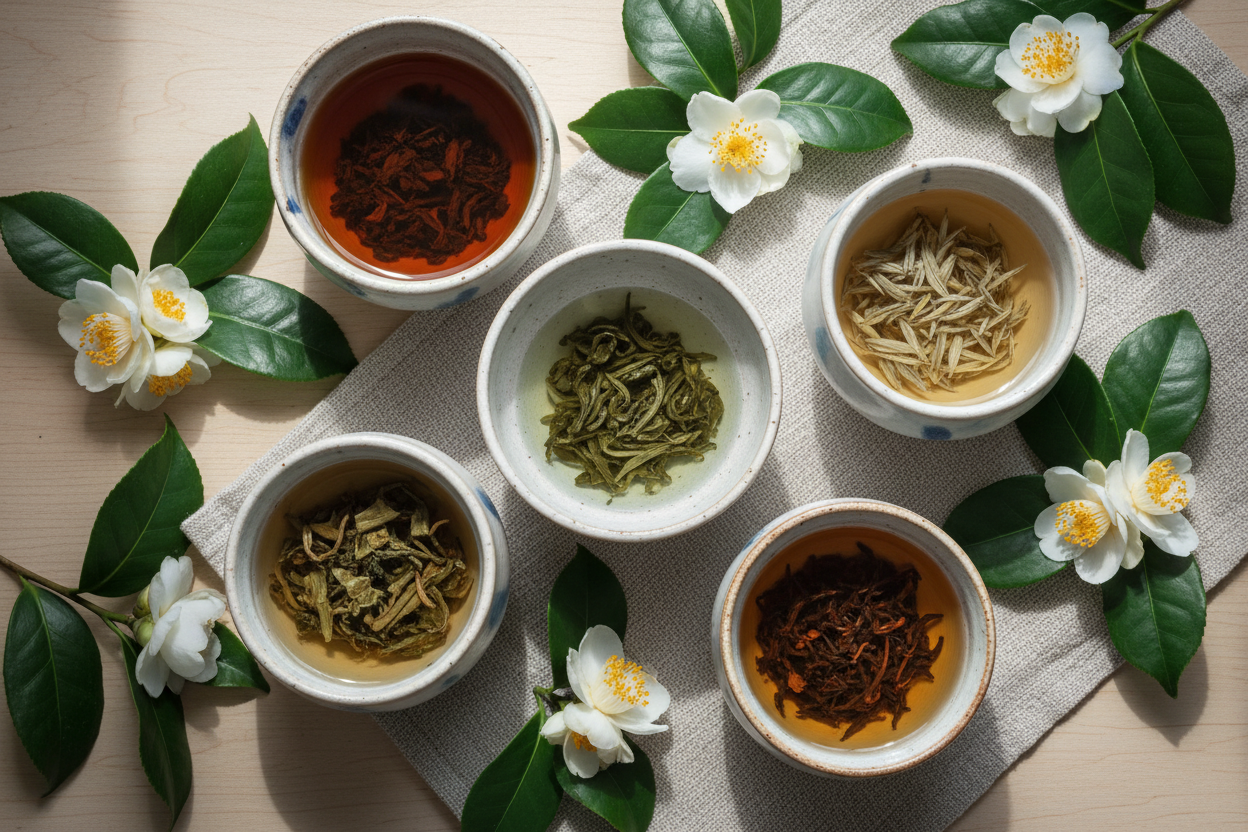
After learning about the fascinating history of tea, it's important to understand that not all teas are the same. Although they all originate from the same plant – Camellia sinensis – the different varieties are distinguished by how the leaves are processed after harvesting.
It is precisely the degree of oxidation and the processing methods that determine the flavour, aroma, colour, and characteristics of each type of tea.
How is tea processed?
Four main types of tea are recognized, distinguishable by their processing.
The Camellia sinensis is a green-leaved shrub that, if not dried immediately after harvesting, quickly begins to oxidize. As the chlorophyll degrades, the leaves progressively become darker.
The goal of processing is to interrupt this oxidation process at a certain point by removing the water from the leaves through the application of heat.
Tea is traditionally classified into four main groups, according to the degree of oxidation.
White Tea
White tea is produced from very young leaves and new buds of the plant.
These leaves undergo virtually no oxidation. In many cases, the buds remain protected from sunlight to prevent chlorophyll formation, preserving their light colour and delicate flavour.
It is considered one of the least processed teas.
Green Tea
In green tea, oxidation is stopped immediately after harvesting through the application of heat.
This process can be carried out using steam, a traditional Japanese method, or by using heated trays, a traditional Chinese method.
As a result, the leaves retain their green colour and develop fresher, more vegetal aromas.
Oolong Tea
Oolong tea has an intermediate degree of oxidation between green tea and black tea.
The oxidation process is stopped before it is complete, resulting in a tea with unique characteristics that combine fresh notes of green tea with more complex aromas of black tea.
Black Tea
Black tea undergoes substantial oxidation before drying.
Interestingly, in China, this type of tea is often referred to as "red tea" due to the colour of the resulting infusion.
Longer oxidation gives it a more intense flavour, a darker colour, and characteristic aromas.
How is Black Tea processed?
Black tea can be produced using two main methods: CTC (Crush, Tear, Curl) or the orthodox method.
Until 1973, orthodox processing, based on the use of whole leaves, predominated.
The CTC method is currently used primarily for medium and low-quality leaves, mainly for the production of tea in bags. In this system, the leaves are mechanically processed.
On the other hand, orthodox processing continues to be used for high-quality teas. This method better preserves the integrity of the leaves and results in a tea more appreciated by connoisseurs and lovers of this beverage.
Why is processing so important?
Although all teas come from the same plant, small differences in processing profoundly alter the final product.
The oxidation time, drying method, and technique used influence the aroma, flavour intensity, infusion colour, and sensory characteristics of each tea.
It is precisely this process that explains why white tea has a delicate flavour, while black tea offers more intense and full-bodied notes.
Conclusion
All types of tea originate from Camellia sinensis. What distinguishes them is how the leaves are processed after harvesting.
White tea undergoes virtually no oxidation, green tea has oxidation quickly stopped, Oolong tea has intermediate oxidation, and black tea is subjected to almost complete oxidation.
Understanding these differences allows for better appreciation of each variety and choosing the most suitable tea for one's taste and consumption moment.
Regardless of the type of tea chosen, all contain natural compounds that have been studied for their effects on the body. Discover the health benefits of tea


Leave a comment
This site is protected by hCaptcha and the hCaptcha Privacy Policy and Terms of Service apply.