

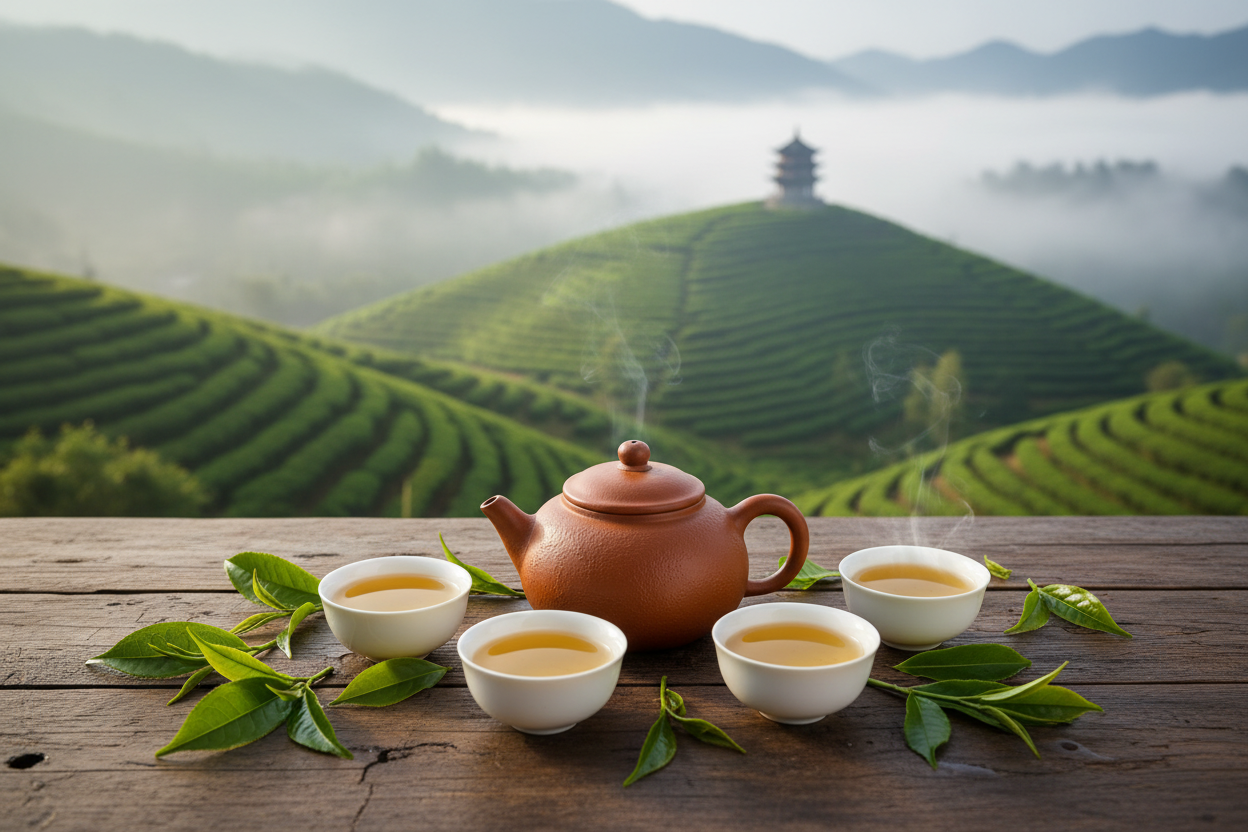
Tea is one of the oldest and most appreciated beverages around the world. Besides its characteristic flavour and aroma, it has a rich history that spans continents, cultures, and centuries. From ancient China to Europe, tea has become a symbol of tradition, conviviality, and well-being.
Although today the word "chá" (tea) is often used to refer to any infusion of plants, fruits, or herbs, this article refers exclusively to tea produced from the Camellia sinensis plant.
What is tea?
Tea is a beverage prepared by infusing leaves of the tea plant – Camellia sinensis – usually prepared with hot water.
Each variety acquires a definite flavour, according to the processing used, which may include oxidation, fermentation, and contact with other herbs, spices, and fruits.
The word "chá" is used in Portugal and Brazil as a synonym for infusions of fruits, leaves, roots, and herbs, containing or not containing tea leaves (tisanes).
This article discusses tea and not tisanes.
Brief history of tea
The use of tea, as a social beverage, dates back at least to the Tang dynasty.
The first Europeans to come into contact with tea were the Portuguese when they arrived in Japan in 1543. Rapidly, tea began to be used throughout Europe, becoming a very popular beverage, especially among the wealthier social classes in France and the Netherlands.
The use of tea in England is attributed to Catherine of Braganza, a Portuguese princess who married Charles II of England.
In 1660, Catherine sponsored the famous "Tea Parties," where tea was initially enjoyed by women and, later, also by men.
Tea was served in cafés and its consumption grew from the end of the 17th century, being consumed at any time of day until the beginning of the 19th century, when the tradition of "Five o'clock Tea" was instituted by the seventh Duchess of Bedford in London.
This tradition became one of the most well-known images of British culture and continues to this day in many tea houses and historic hotels.
Why do some languages say "Tea" and others say "Chá"?
The Chinese character for tea has two completely distinct forms of pronunciation.
One of them is "té", derived from the Min dialect, used in the coastal regions of China and spread through maritime routes. It was this pronunciation that gave rise to the words used in many European languages.
The other pronunciation is "chá", used in Cantonese and Mandarin, meaning "to pick" or "to gather". This version spread mainly through land routes and through Portuguese trade links.
This duality caused non-Chinese languages to be divided into two main groups.
Languages that use derivatives of "té"
- German
- English
- French
- Danish
- Hebrew
- Hungarian
- Finnish
- Indonesian
- Italian
- Latvian
- Tamil
- Dutch
- Spanish
Languages that use derivatives of "chá"
- Portuguese
- Japanese
- Hindi
- Persian
- Romanian
- Czech
- Russian
- Tibetan
- Arabic
- Vietnamese
- Korean
- Thai
- Greek
- Swahili
- Croatian
This linguistic curiosity shows how different trade routes influenced the way tea reached various countries around the world.
Tea as a symbol of culture and tradition
Over the centuries, tea has ceased to be just a beverage to become an integral part of the culture of many peoples.
In China and Japan, the tea ceremony represents a moment of respect, tranquility, and contemplation.
In England, afternoon tea continues to be a cherished tradition in countless homes and hotels.
In Portugal, although coffee is now the most consumed beverage, tea still holds an important place in the daily lives of many families, often enjoyed during moments of rest or socializing.
Conclusion
From its origin in Asia to its expansion throughout the world, tea has accompanied the history of different civilizations and continues to be one of the most consumed beverages globally.
Portuguese influence was decisive in its arrival in Europe and, later, Catherine of Braganza helped transform tea into one of the greatest British traditions.
Today, regardless of the variety chosen, tea continues to unite people, cultures, and generations, keeping alive a tradition hundreds of years old.
Tea can be processed in different ways, giving rise to white, green, Oolong, and black tea. Learn about the different types of tea.


Leave a comment
This site is protected by hCaptcha and the hCaptcha Privacy Policy and Terms of Service apply.