

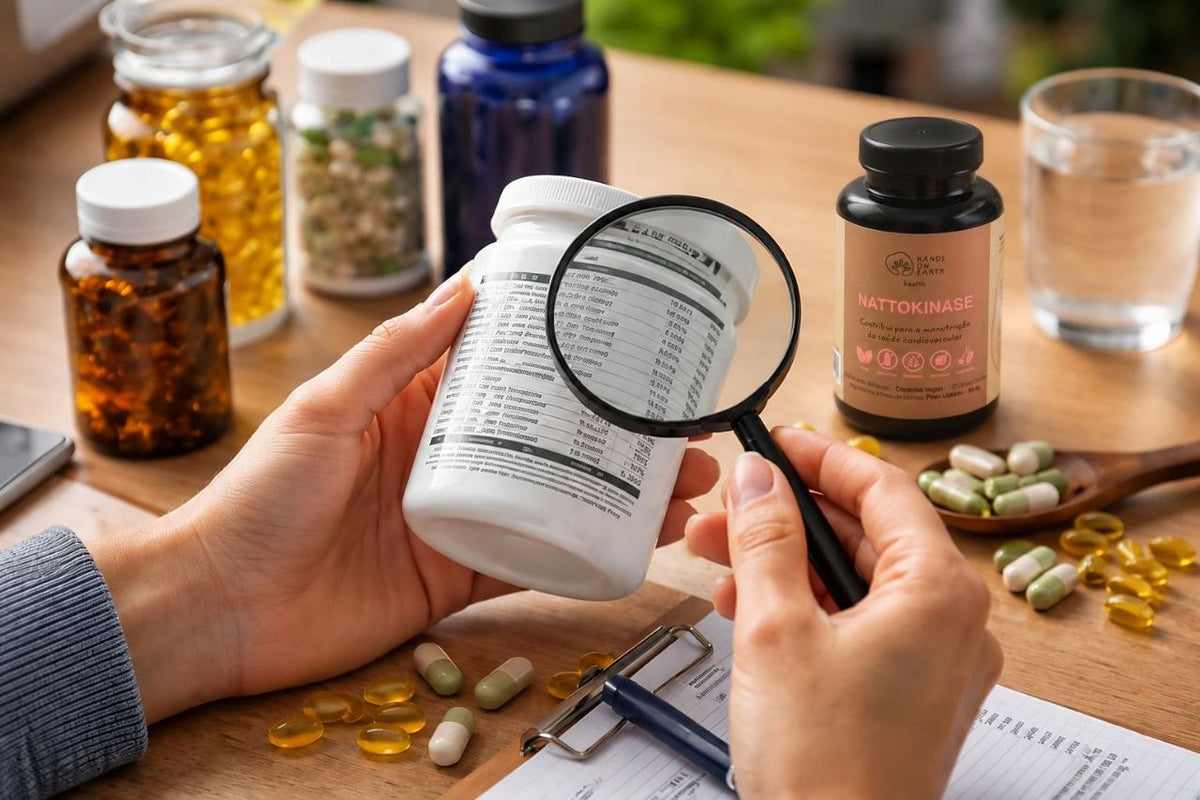
In the previous article, we explored the difference between active ingredients and excipients and explained that each ingredient can play a specific role in a food supplement.
But how can we apply this information in practice?
The label helps us understand what a supplement contains, what the recommended daily dose is, what other ingredients are present, and what precautions should be taken into account.
In this article, we will analyze a practical example to learn how to interpret this information and compare supplements in a more informed way, beyond just the price or the claims presented on the packaging.
1. What information should we look for on a food supplement label?
The labeling of food supplements is subject to European and national rules that aim to ensure that consumers receive important information about composition, usage, and precautions to be taken.
When reading the label, we should look for the following information.
Identification and composition
- Product name: must be identified as a "food supplement".
- Ingredients: allows you to know the nutrients, other substances that characterize the product, and additional ingredients used in its formulation.
- Amount of ingredients: indicates the quantity of nutrients or other substances with a nutritional or physiological effect per recommended daily dose.
- Percentage of Nutrient Reference Values (NRV): indicated for vitamins and minerals, where applicable.
Usage and precautions
- Recommended daily dose: indicates the amount of supplement to be consumed per day.
- Mandatory warnings: include the indication not to exceed the recommended daily dose, not to use the supplement as a substitute for a varied diet, and to keep it out of the reach of young children.
- Storage and usage conditions: where applicable, indicate how to store and use the product.
Other important information
- Allergens: must be declared in accordance with the applicable legal requirements.
- Net quantity: indicates the amount of product contained in the packaging.
- Date of minimum durability and batch number: help verify shelf life and identify the product.
- Responsible operator: identifies the company responsible for the food information, including its address.
- Language: mandatory information must be presented in a language easily understood by consumers in the market where the product is sold, in accordance with applicable rules.
This information allows you to better understand the supplement and compare products in a more informed way. However, a label alone does not allow one to conclude that a product is more effective or more suitable for everyone.
Do you want to consult the legislation?
Food supplements marketed in Portugal are subject to European and national rules covering labeling, composition, safety, and the claims used in product communication.
Among the main statutes are:
- Directive 2002/46/EC and Decree-Law no. 136/2003, as currently amended: establish specific rules for food supplements.
- Regulation (EU) No 1169/2011: establishes general rules on food information to consumers, including the list of ingredients and the declaration of allergens.
- Regulation (EC) No 1924/2006: regulates nutrition and health claims used in labeling and advertising.
- Regulation (EU) No 432/2012: establishes a list of authorized health claims, subject to applicable conditions.
- Regulation (EC) No 1333/2008: regulates food additives and their conditions of use.
2. Practical example: how to read an omega-3 supplement label?
Let’s analyze the label of an omega-3 food supplement to understand how to interpret ingredient amounts, the recommended daily dose, additional ingredients, and warnings.
2.1. Product identification, claims, and features

What does the label indicate?
The packaging displays the claim "Omega-3 EPA/DHA contribute to the normal function of the heart", the indications dairy-free, gluten-free, and sugar-free, the designation "food supplement", 100 softgels, and a net weight of 100.5 g.
What does it mean?
This information helps identify the product and some of its features. The claim regarding heart function must comply with the conditions legally established for authorized health claims. You can consult Regulation (EC) No 1924/2006 on nutrition and health claims, and Regulation (EU) No 432/2012, which establishes a list of authorized health claims.
Statements regarding the absence of milk and dairy derivatives, gluten, and sugar must also comply with applicable legal requirements. For gluten, you can consult Implementing Regulation (EU) No 828/2014.
It is important to distinguish between the features declared on the packaging and the benefits we might expect individually. The presence of a health claim does not mean the supplement prevents or treats diseases, nor that it is suitable for everyone.
2.2. Composition and nutritional information

Amount of ingredients per daily dose
The label declares the following amounts per capsule:
- Fish oil: 1000 mg
- EPA (eicosapentaenoic acid): 330 mg
- DHA (docosahexaenoic acid): 220 mg
- Vitamin E: 5 mg α-TE
What does it mean?
The total amount of fish oil does not correspond to the amount of EPA and DHA. In this example, each capsule provides 550 mg of EPA and DHA in total, or 1100 mg per daily dose of two capsules, consisting of 660 mg of EPA and 440 mg of DHA.
When comparing omega-3 supplements, it is important to check the amount of EPA and DHA per recommended daily dose, not just the total amount of fish oil.
Nutrient Reference Values (NRV)
The label presents an NRV percentage for vitamin E, but not for EPA and DHA.
What does it mean?
NRVs are reference values used in the labeling of vitamins and minerals. They help provide context for the amount provided but do not constitute individualized recommendations and do not, in themselves, demonstrate the efficacy of a supplement.
There is no regulatory NRV equivalent for EPA and DHA. To compare these substances, we must consider the amounts declared per daily dose.
List of ingredients and additional ingredients
The label identifies fish oil, vitamin E, an antioxidant mixture, and ingredients used in the manufacture of the capsule, including gelatin, glycerin, and purified water. The antioxidant mixture includes extract rich in alpha-tocopherol, ascorbyl palmitate (E304(i)), and propyl gallate (E310).
What does it mean?
The list of ingredients allows you to better know the product's composition and understand the function of some of its components.
In this example:
- Fish oil: source of EPA and DHA.
- Vitamin E and other antioxidants: help protect the formulation against oxidation.
- Gelatin: material used in the manufacture of the soft capsule.
- Glycerin and water: ingredients used in the capsule formulation.
The presence of a food additive or an E-number does not, in itself, mean that the ingredient is harmful. Its assessment must consider the technological function, authorization, and applicable conditions of use, as well as the available scientific evidence.
To learn more, see our article [Food additives in supplements: are they safe?].
Allergens
The label identifies fish as an allergen.
What does it mean?
This information is particularly important for people with a fish allergy. The list of ingredients and allergen declaration should be checked before use.
2.3. Recommended daily dose, warnings, batch, and storage

Recommended daily dose and warnings
The label recommends two capsules per day and includes warnings regarding the use of the supplement.
What does it mean?
The recommended daily dose indicates the amount to consume per day. The warning not to exceed this dose alerts the consumer not to surpass the indicated amount.
The label also indicates that the supplement should not replace a varied diet and that it should be kept out of the reach of young children. Other precautions, including those regarding children, pregnant, and breastfeeding women, should be interpreted according to the specific product label.
Batch, durability, and storage
The label presents the batch number, the date of minimum durability, the details of the responsible operator, and the storage conditions.
What does it mean?
This information helps to identify the product, verify its shelf life, know the recommended storage conditions, and contact the responsible company when necessary.
3. Practical checklist: how to compare two food supplements?
When comparing two supplements, do not limit yourself to the price, the number of capsules, or the claims on the packaging. Use this checklist to identify the most relevant differences.
1. Amount per daily dose
☐ Compare the amount of active ingredients per recommended daily dose, not just per capsule.
☐ Check how many capsules or tablets you should take per day.
☐ Confirm the effective amount of the nutrients you wish to compare, such as EPA and DHA in an omega-3 supplement.
2. Additional ingredients
☐ Read the full list of ingredients, including those used in the capsule manufacture.
☐ Try to understand the function of additional ingredients, such as antioxidants, bulking agents, and anti-caking agents.
☐ Check for the presence of allergens or ingredients you wish to avoid.
☐ Do not assume that a shorter list of ingredients automatically means higher quality or safety.
3. Suitability for your needs
☐ Confirm if the composition matches the intended purpose.
☐ Consider the daily dose, your individual needs, any allergies, and the medications you are taking.
☐ If you have questions about the suitability of the supplement, ask a healthcare professional for advice.
4. Quality information
☐ Confirm whether the manufacturer or responsible operator is identified.
☐ Look for verifiable information regarding quality control and, where relevant, tests for purity, contaminants, and stability.
☐ If certificates or laboratory analyses are presented, check what they evaluate and if they correspond to the product in question.
☐ Distinguish between quality management system certifications and specific product analyses or studies on their efficacy.
5. Price and number of doses
☐ Compare the price per daily dose, not just the price of the packaging.
☐ Consider the amount of active ingredient provided per dose to see if you are comparing equivalent products.
Caution: none of these criteria, in isolation, guarantees the safety, quality, or efficacy of a supplement. The goal is to gather enough information to compare products in a more conscious way that is appropriate for your needs.


Leave a comment
This site is protected by hCaptcha and the hCaptcha Privacy Policy and Terms of Service apply.